Hardly a day goes by without researchers discovering a new raw material that could turn the battery sector upside down. The latest one? A battery that uses… cows as building blocks. It sounds too crazy to be true. And yet the idea has potential.
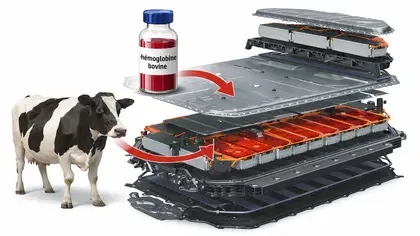
Imagine: a battery that you can charge in just a few seconds, that lasts more than thirty years, and in which cattle provide the key components. It sounds like a crazy invention from some science fiction TV series, but this is science that is being seriously researched.
Researchers from the University of California in Los Angeles (UCLA) have published a remarkable new battery chemistry in the scientific journal Small. The starting point? Proteins that remain as a by-product of the meat industry. In technical terms: bovine serum albumin, the most common protein found in the blood of our grazing cows.
Edison already believed in it
The story actually begins more than a hundred years ago. In 1900 there were more electric cars on the road in America than gasoline cars. Thomas Edison strongly believed in the nickel-iron battery as the future of the automobile: durable, powerful and with a peak driving range of 160 kilometers for that time. But the technology did not succeed, because the combustion engine won the battle and nickel-iron chemistry also failed due to several disadvantages.
However, the international research team from UCLA has revived this forgotten Edison chemistry. The result is very promising: their prototype charges in seconds instead of hours and survived more than 12,000 charge and discharge cycles. That is the equivalent of more than thirty years of daily charging (from zero to one hundred percent – in practice it would last even longer), an unprecedented lifespan. By comparison, the widely used NMC technology in today’s electric cars can handle about 800 cycles.
Molecular architect
But how do cattle fit into this? The classic problem with nickel-iron batteries is that metal particles in the electrodes clump together, which drastically reduces efficiency. For their solution, the researchers drew inspiration from nature: bones and shells are also formed through proteins that act as scaffolding for mineral deposition.
It gets a bit technical. The bovine proteins function as a kind of molecular mold in which nickel and iron ions can settle with atomic precision. The metal particles that form are smaller than 5 nanometers (to give an idea: you would need up to 20,000 of these clusters to span the width of a human hair). These mini-particles are then mixed with graphene and baked at high temperature, where the proteins carbonize and encapsulate the metal clusters.
The result is that all atoms participate in the charging process, which explains the strongly improved performance. The smaller particles also provide a much better ratio between surface area and volume. In addition, the ions have to move less back and forth during charging and discharging, which further increases efficiency.
Soon in our cars?
Although fast charging is an important quality for modern batteries, there is a trade-off. The energy density of the prototype still does not reach that of today’s lithium-ion batteries, which means that driving range would lag behind. The sources give no exact figures, but some research on the internet suggests that the value is often ten times lower. That driving range from Edison’s time would therefore hardly improve if the technology were used in cars. The gain in reliability and charging speed would then disappear.
Apart from that, there are also ethical and climate-related questions to be asked about using livestock as an energy source, even if it concerns residual waste. But for now, the idea itself is what matters. The team is already exploring alternatives to bovine proteins: natural polymers that are cheaper and easier to scale. By the time everything becomes commercially viable, the cow as an expensive battery raw material may already be history.

 Benable.blog