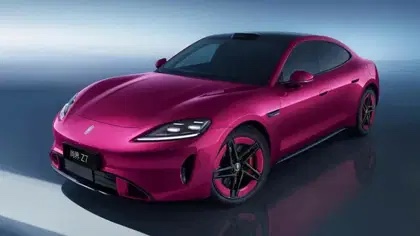
The SAIC Z7 is an electric sedan developed by the Chinese giant SAIC in collaboration with Huawei. Its design strongly resembles that of the Porsche Taycan, but the price is expected to be about four times lower. It illustrates the aggressive strategy of Chinese manufacturers in the electric vehicle market.
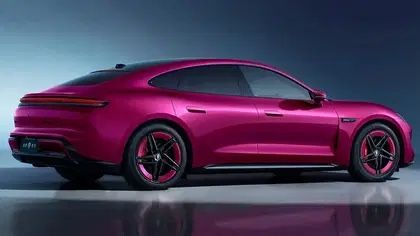
With its fastback profile, sloping roofline, muscular wheel arches, and flush door handles, the SAIC Z7 clearly echoes the design of the Porsche Taycan. The similarities can be seen in the roofline, the shape of the doors, and even the positioning of the side mirrors. However, SAIC attempts to differentiate itself with some distinctive design elements, such as a lighting signature with multiple LED points and a continuous rear light strip called Star River, which has already appeared on other models from the group.
At around five meters long, the Z7 fits into the segment of large premium electric sedans. While it once seemed that Chinese manufacturers had stopped directly copying certain European models, this car shows that SAIC—ironically a partner of Volkswagen in China—may still be falling back into old habits.
A Technological Showcase for Huawei
The Z7 is not just a design exercise. It also serves as a technological showcase for Huawei, a key partner in the project through the Harmony Intelligent Mobility Alliance (HIMA). The model is equipped with the Qiankun ADS 4.0 driver-assistance system, which relies on a combination of cameras, radars, and LiDAR sensors mounted on the roof.
Inside, the sedan features the HarmonyOS ecosystem, offering a highly connected digital cockpit with multiple screens integrated into a sleek dashboard. The Z7 also benefits from a modern electric platform with an 800-volt architecture, enabling extremely fast charging. Under optimal conditions, it can add roughly 200 km of driving range in just five minutes.
Promising Performance
Although the final specifications are not yet fully confirmed, several versions are expected. Early information suggests battery capacities of around 80 to 100 kWh, with both rear-wheel drive and all-wheel drive variants.
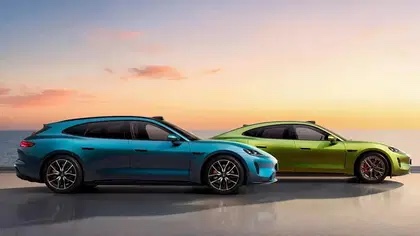
The most powerful version is expected to accelerate from 0 to 100 km/h in under 4 seconds, while the driving range could exceed 700 km according to the Chinese CLTC cycle. A station-wagon version, the Z7T, inspired by the Taycan Sport Turismo, is also planned to expand the lineup and offer greater practicality.
A “Temu-Style” Price
The most striking argument remains the price. In China, the Z7 is expected to be offered between 250,000 and 350,000 yuan, or roughly €32,000 to €45,000. By comparison, a Porsche Taycan starts at over 900,000 yuan on the Chinese market.
Because it costs only a fraction of the German sports sedan, the SAIC Z7 looks like an excellent deal on paper. Its aggressive pricing once again demonstrates that Chinese manufacturers can build cars with an exceptional price-to-performance ratio. Whether Porsche will appreciate this apparent “copy-and-paste” approach in such an important market is another question. A legal dispute in the near future cannot be ruled out.

 Benable.blog